
Canada’s healthcare sector is projected to face a shortage of over 60,000 nurses by 2026. This demand creates a significant opportunity for international professionals, particularly from India, to secure high-paying roles with a clear path to Permanent Residency (PR).
Types of Nursing Roles and Salary Expectations (2026)
Salaries in Canada vary by province, specialization, and years of experience. On average, nurses earn between $85,000 and $105,000 CAD annually.
| Role | Average Annual Salary (CAD) | Key Work Settings |
| Nurse Practitioner (NP) | $125,000 – $160,000+ | Primary care clinics, rural centers |
| Registered Nurse (RN) | $90,000 – $110,000 | Hospitals, ICUs, acute care |
| Critical Care / ICU Nurse | $110,000 – $145,000 | ERs, Trauma centers, ICUs |
| Licensed Practical Nurse (LPN) | $65,000 – $85,000 | Long-term care, home health |
| Nurse Aide / HCA | $45,000 – $58,000 | Nursing homes, assisted living |
Note: Salaries in northern territories (Nunavut, NWT) are often higher, with experienced RNs exceeding $130,000 CAD to compensate for remote locations.
Visa Sponsorship Pathways
Canada actively recruits international nurses through several immigration and work permit streams:
- Express Entry (Healthcare Draws): The Federal government holds category-based draws specifically for healthcare workers. A valid job offer can significantly boost your Comprehensive Ranking System (CRS) score.
- Provincial Nominee Programs (PNP): Provinces like Ontario, British Columbia, and Alberta have dedicated streams for nurses (e.g., BC’s Healthcare Professional category).
- LMIA-Based Work Permits: Employers who cannot find local talent can apply for a Labour Market Impact Assessment (LMIA) to sponsor an international nurse directly.
- The “Study-to-Work” Path: International students completing a nursing program in Canada are eligible for a Post-Graduation Work Permit (PGWP), which serves as a bridge to PR.
Mandatory Requirements for International Applicants
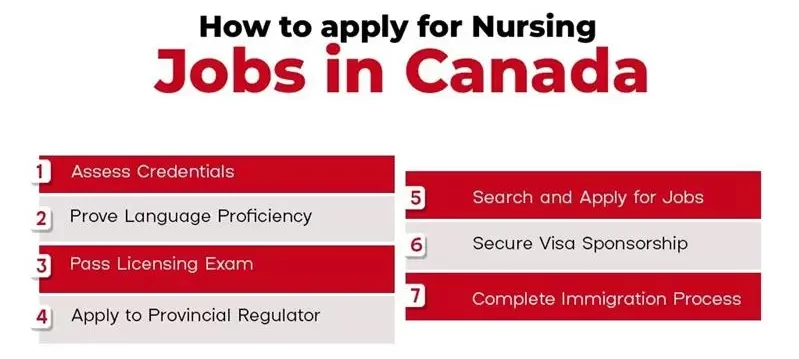
To practice in Canada, you must meet rigorous provincial standards:
- NNAS Assessment: All internationally educated nurses (IENs) must first apply to the National Nursing Assessment Service (NNAS). They evaluate your education and experience against Canadian standards.
- Language Proficiency: You must demonstrate fluency in English or French.
- IELTS Academic: Generally requires a 7.0 overall (with no band below 7.0).
- CELBAN: A nursing-specific English test often preferred by IENs.
- Licensing Exams:
- RNs: Must pass the NCLEX-RN.
- LPNs: Must pass the CPNRE or equivalent provincial exam.
- Provincial Registration: After NNAS approval and passing your exams, you must register with the regulatory body in your target province (e.g., CNO in Ontario or BCCNM in BC).
7-Step Application Process
- NNAS Registration: Create an account at nnas.ca. This stage takes 12–16 weeks.
- Language Testing: Sit for the IELTS or CELBAN.
- Advisory Report: Receive your NNAS report, which determines if your education is “comparable” to Canadian standards.
- Provincial Application: Apply to the provincial nursing college. They may require “bridging” courses if gaps are found in your training.
- Pass the Exam: Schedule and pass the NCLEX-RN or CPNRE.
- Job Search: Use the Canada Job Bank or LinkedIn to find employers offering LMIA sponsorship.
- Visa Application: Apply for your work permit or PR through Express Entry/PNP once you have your license and a job offer.
Frequently Asked Questions
Can I work without IELTS?
Almost never. Only those from specific English-speaking countries or those with extensive English-medium education may occasionally be exempt, but Indian nurses generally must provide a score.
What is the highest-paying province?
Alberta and the Northern Territories typically offer the highest hourly wages and lowest tax burdens for nurses.
Is my Indian experience recognized?
Yes, provided it is verified through the NNAS. Post-registration experience of 1–2 years is highly preferred by sponsoring employers.