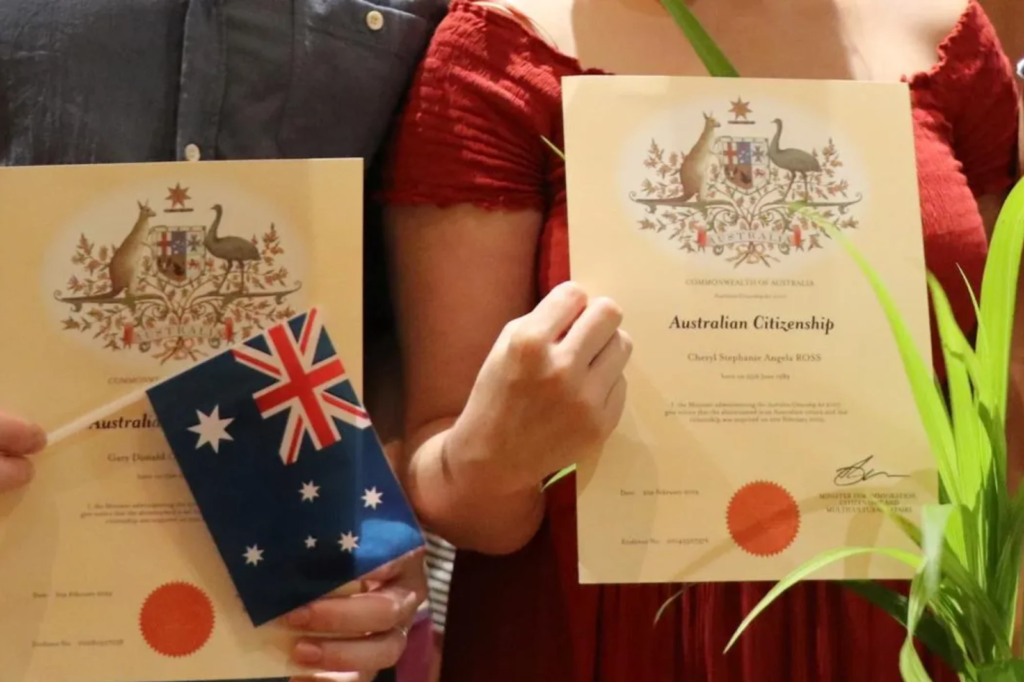
Australian citizenship is the final step in the migration journey, transitioning you from a permanent resident to a full member of the Australian community with the right to vote and hold an Australian passport. In 2026, the process remains streamlined via ImmiAccount, but specific residency and value-based requirements must be met.
Different Pathways to Citizenship
| Pathway | Who is it for? | Key Requirements |
| By Conferral | Permanent Residents (18–59) | 4 years residency, pass the test, good character. |
| By Conferral (60+) | Permanent Residents (60+) | 4 years residency, interview (no test), good character. |
| By Descent | Born overseas to an AU parent | Proof that a parent was a citizen at time of birth. |
| NZ Pathway | NZ citizens on SCV (subclass 444) | Eligible for direct citizenship if living in AU for 4 years. |
Eligibility Requirements (2026)
To be eligible for citizenship by conferral, you must satisfy the General Residence Requirement:
- Total Time: You must have lived in Australia on a valid visa for the past 4 years.
- PR Status: You must have been a Permanent Resident for the last 12 months.
- Absences: You cannot have been out of Australia for more than 12 months in total over the 4-year period, and no more than 90 days in the 12 months immediately before applying.
- Character: You must pass a “Good Character” assessment (police checks for any country you lived in for 90+ days while holding a PR).
The 7-Step Application Process
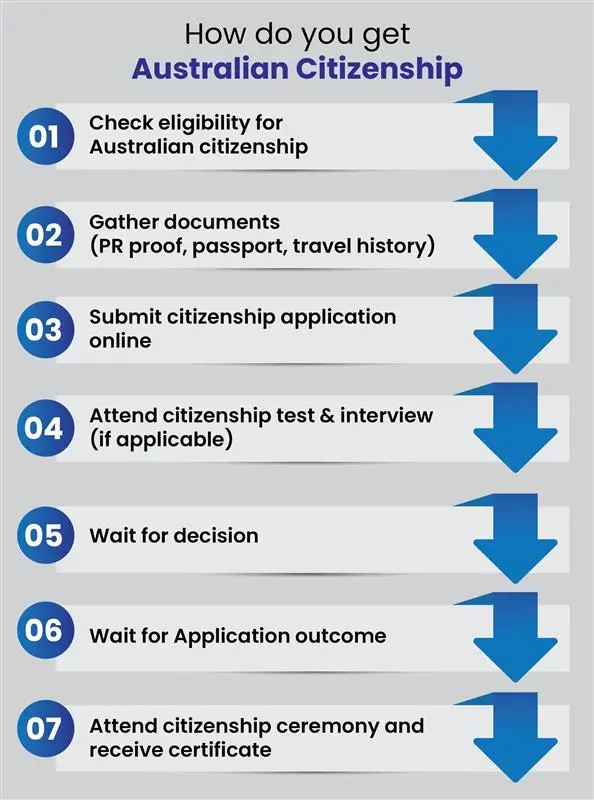
- Eligibility Check: Confirm you meet the 4-year residency rule using the Department of Home Affairs’ online residency calculator.
- Document Preparation: Gather identity documents (birth certificate, passport), PR evidence, and overseas penal clearances.
- Lodge Application: Submit via ImmiAccount. Online applications are processed significantly faster than paper ones.
- Citizenship Appointment: Attend an interview to verify your original documents and sit the Citizenship Test.
- Wait for Decision: Processing times in 2026 currently average 9 to 15 months.
- Approval Outcome: You will receive a written notification. If approved, you wait for your ceremony invitation.
- Citizenship Ceremony: Make the Pledge of Commitment in front of a presiding officer. This is the moment you legally become a citizen.
Australian Citizenship Test & Fees (2026)
The Test (Aged 18–59)
The test is computer-based, multiple-choice, and conducted in English.
- Format: 20 questions based on the booklet Australian Citizenship: Our Common Bond.
- Pass Mark: At least 75% overall.
- Critical Section: You must answer all 5 Australian Values questions correctly (100% in this section).
Application Fees (Current as of 2026)
Note: Fees are adjusted every July 1st based on the Consumer Price Index (CPI).
| Application Type | Standard Fee | Concession |
| General Eligibility (Form 1300t) | AUD 575 | AUD 80 |
| Other Situations (Form 1290) | AUD 350 | AUD 40 |
| Children (<16) on parent’s form | Free | N/A |
Common Reasons for Rejection
- Residency Breaches: Being outside Australia for more than 90 days in the year before applying.
- Character Issues: Undisclosed criminal convictions or outstanding debts to the Australian government.
- Identity Gaps: Inability to provide a continuous document trail from birth to the present.
- Failed Test: Failing the “Australian Values” portion of the test.
Tips to Improve Your Chances of Australian Citizenship Approval
To ensure a smooth transition from permanent resident to citizen, consider these strategic recommendations:
- Audit Your Residency: Before submitting, use the official residency calculator. Applying even one day early can result in an automatic rejection and loss of your application fee.
- Maintain Clean Records: Ensure all outstanding debts to the Australian government (such as unpaid taxes or centerlink overpayments) are settled.
- Documentation Consistency: Ensure your name, date of birth, and place of birth are consistent across all historical documents. Any discrepancies should be explained with official name-change or marriage certificates.
- Stay in Australia: Avoid planning long overseas trips immediately before or during the processing of your application, as being onshore is generally required for the test and ceremony.
- Study the Values: Pay special attention to the “Australian Values” section of the study guide, as this part of the test requires a perfect score of 100%.
Frequently Asked Questions
How long must I wait to get citizenship after receiving PR?
You must have lived in Australia for a total of 4 years on a valid visa. At least 12 months of that time must have been as a Permanent Resident.
Can I apply for Australian citizenship if I am currently overseas?
In most cases, no. You must be physically present in Australia when you lodge your application and when you attend the citizenship ceremony.
Is an English test like IELTS required?
No formal English language testing is required for citizenship. Your English proficiency is assessed through your ability to complete the application, pass the citizenship test, and participate in the interview.
Can I include my children in my application?
Yes. Children under the age of 16 can be included in the application of a responsible parent at no additional cost. Children aged 16 and 17 must usually apply on their own and pay a fee.
What happens if I fail the citizenship test?
If you fail the test, you can usually retake it on the same day if time permits, or reschedule for a later date. There is no limit to the number of times you can attempt the test, though multiple failures may trigger further review.
Is citizenship automatic after 4 years?
No. Citizenship is a separate legal process. You must proactively apply, meet all criteria, and take the Pledge of Commitment.
Can I get citizenship through investment?
No. While there are investment visas that lead to Permanent Residency, there is no direct “Citizenship by Investment” program. You must still meet the standard residency and character requirements.