
In 2026, accounting continues to be a cornerstone of Australia’s skilled migration strategy. With a projected shortage of 30,000 professionals through 2028, the demand for qualified accountants, auditors, and tax specialists is at an all-time high.
Accountants currently lead the list of in-demand professions in Australia, driven by critical shortages in the finance, mining, construction, and real estate sectors. For skilled international professionals, particularly those from India with CA or CPA credentials, cities like Sydney, Melbourne, and Brisbane offer extensive career opportunities.
The Jobs and Skills Australia (JSA) 2025–26 Skills Priority List highlights accounting as a top-tier shortage occupation, with a projected need for over 30,000 additional professionals by late 2026. This sustained demand makes the field a primary gateway for career growth and permanent residency (PR).
Eligibility and Requirements
To transition into the Australian market, professionals must meet specific criteria:
- Academic Credentials: A bachelor’s degree or higher in accounting/finance. Qualifications are assessed by bodies like CPA Australia, CA ANZ, or IPA.
- English Proficiency: A minimum score of IELTS 7.0 (or PTE equivalent) in all four components is standard for migration and professional membership.
- Work Experience: Usually, 1–3 years of post-qualification supervised experience is required. Experience gained in India is generally recognized.
- Skills Assessment: A positive outcome from a relevant assessing authority is mandatory for most visa pathways.
- Professional Membership: Joining an Australian professional body involves completing specific modules (ethics/law) and fulfilling Continuing Professional Development (CPD) requirements.
Step-by-Step Pathway to Migration
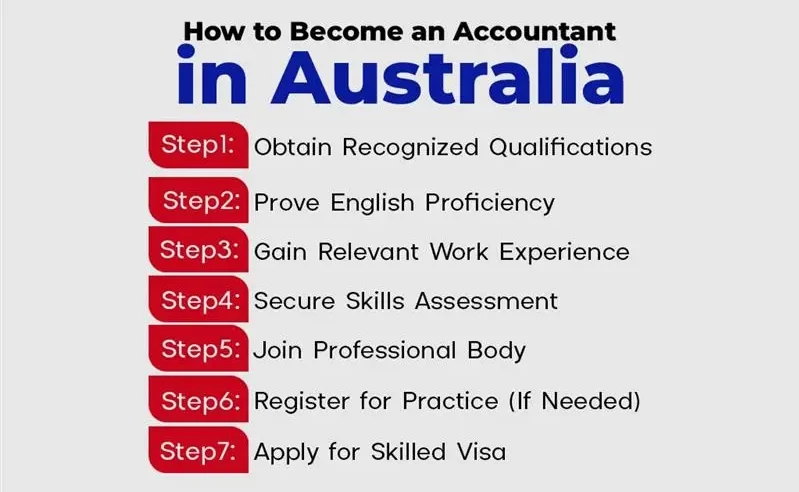
- Skills Verification: Submit your transcripts and CV to CA ANZ, CPA Australia, or IPA for a formal assessment against Australian standards.
- English Testing: Achieve the required scores in IELTS or PTE Academic.
- Professional Membership: Enroll in the local CPA or CA program. Indian CAs may receive significant exemptions but must complete ethics training.
- Tax Registration (Optional): If planning to practice publicly, register with the Tax Practitioners Board (TPB).
- Visa Application: Submit an Expression of Interest (EOI) via SkillSelect. High-demand roles qualify for:
- Subclass 189: Skilled Independent (Points-tested PR)
- Subclass 190: Skilled Nominated (State-sponsored PR)
- Subclass 491: Skilled Work Regional (Provisional)
Job Roles and Specializations
The Australian market offers diverse roles for qualified accountants, many of which qualify for employer sponsorship (Subclass 482):
- Management and Financial Accountants
- Taxation Accountants and Auditors (Internal/External)
- Forensic and Cost Accountants
- Payroll and Systems Accountants
Major firms—including the “Big Four” (PwC, Deloitte, EY, KPMG)—and mid-tier agencies actively recruit international talent to fill the gap left by a declining number of domestic graduates.
2026 Salary Estimates (AUD)
Salaries reflect the high demand and vary by location and experience level:
| Experience Level | Annual Salary Range (AUD) | Key Focus Areas |
| Entry-Level (0–3 yrs) | $68,000 – $75,000 | Bookkeeping, basic reporting, audit support |
| Mid-Career (4–9 yrs) | $85,000 – $115,000 | Complex analysis, budgeting, tax compliance |
| Senior (10+ yrs) | $120,000 – $150,000+ | Strategic planning, team leadership, risk management |
Note: Regional roles may offer slightly lower base salaries but provide significant advantages in visa processing times and lower living costs.

Frequently Asked Questions (FAQ)
Who regulates accountants in Australia?
Professional standards and memberships are governed by CPA Australia, Chartered Accountants Australia and New Zealand (CA ANZ), and the Institute of Public Accountants (IPA). The Tax Practitioners Board (TPB) regulates tax agents, while ASIC oversees company auditors. Starting July 2026, many accountants will also be regulated by AUSTRAC under expanded anti-money laundering (AML/CTF) laws.
How many accountants are there in Australia?
There are approximately 250,000 accountants currently working in Australia. However, the Australian Bureau of Statistics (ABS) forecasts that the country will require 338,362 professionals by late 2026 to keep pace with economic growth.
Is there a shortage of accountants in Australia?
Yes. Accounting remains on the National Skills Priority List. The shortage is particularly acute for external auditors and taxation accountants. The gap is driven by a 50% decline in domestic accounting graduates over the last decade and increased demand for compliance expertise.
Does Australia need accountants?
Absolutely. They are categorized as a “priority occupation” for migration. Demand is highest in the professional services, mining, and financial sectors. To meet this need, the government has streamlined PR pathways for skilled international applicants.
Who are the top 10 accounting firms in Australia?
The leading firms for 2026 include the “Big Four”—PwC, Deloitte, EY, and KPMG—followed by BDO, Grant Thornton, RSM Australia, Pitcher Partners, William Buck, and Findex.
How much do accountants make in Australia?
- Entry-level: AU$55,000 – AU$75,000
- Mid-career: AU$85,000 – AU$115,000
- Senior/Specialized: AU$120,000 – AU$150,000+
Salaries are highest in Western Australia (mining sector) and New South Wales (financial hubs).
Conclusion
With over 25,000 vacancies annually through 2028, Australia remains a premier destination for accountants. By securing a skills assessment and meeting English requirements, professionals can access stable, high-paying roles and a clear path to permanent residency.